Everyday Puppy
Everyday Puppy
Couldn't load pickup availability
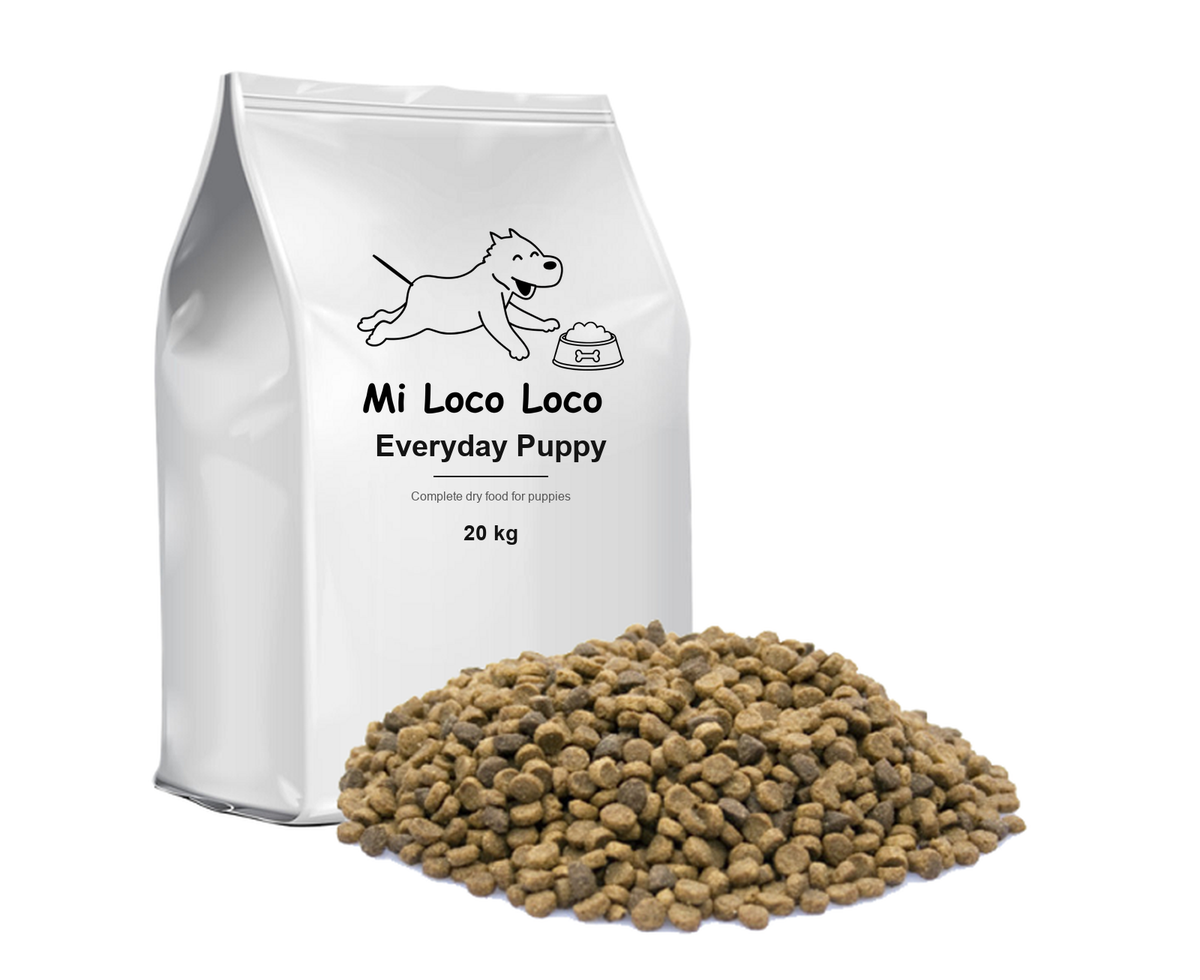
For puppies — under 6 months. Complete dry food, packed under our own label and shipped from the Netherlands.
Pick the bag size that fits your dog. A 10 kg bag is about a month of food for a medium-sized puppy; take 4 kg to try it out, or 20 kg for a large breed.
How much to feed
How much to feed
A puppy eats for the weight it is going to be, not the weight it is today. Find your dog’s expected grown-up weight in the left column.
| Expected adult weight | Up to 3 months | 4 to 6 months |
|---|---|---|
| 1–5 kg | 30–60 g | 60–90 g |
| 5–10 kg | 40–70 g | 70–120 g |
| 10–25 kg | 90–140 g | 140–270 g |
| 25–35 kg | 110–230 g | 230–320 g |
| 35–45 kg | 120–270 g | 270–380 g |
| 45–60 kg | 140–300 g | 300–430 g |
| 60–80 kg | 175–450 g | 400–600 g |
Start with four to five small meals a day, easing back to two by six months. For very young puppies, moisten the kibble slightly with water so it softens. Always leave fresh, not too cold, drinking water available.
Feeding table from our supplier. This recipe provides 376 kcal per 100 g. Every young dog grows at its own pace — weigh yours regularly and adjust within the range.
Ingredients
Ingredients
Cereals, meat and animal derivatives, oils and fats, vegetable by-products, vegetable protein extracts, fish and fish by-products, minerals, yeast.
Analytical constituents
Analytical constituents
Crude protein 26.0% · Crude fat 17.0% · Crude fibre 2.0% · Crude ash 6.0% · Calcium 1.4% · Phosphorus 1.0% · Moisture 9.0%
Energy: approximately 376 kcal per 100 g, calculated from the constituents above.
Nutritional additives per kg
Nutritional additives per kg
Vitamin A (alpha-retinyl acetate) 18500 IU, vitamin D3 (cholecalciferol) 1850 IU, vitamin E (all-rac-alpha-tocopheryl acetate) 165 mg, copper (copper(II) sulphate pentahydrate) 14.0 mg, zinc (zinc sulphate monohydrate) 105.0 mg, iron (iron(II) sulphate monohydrate) 112.0 mg, manganese (manganese(II) oxide) 13.0 mg, iodine (calcium iodate, anhydrous) 1.9 mg.
Share